
Tajweed
Online Tajweed Classes for Kids and Adults
You can read the Quran, but something still feels off. Maybe your "ق" sounds like "ك". Maybe you stop where you should not, or you hold a letter too long. Many readers carry these small mistakes for years because nobody ever corrected them.
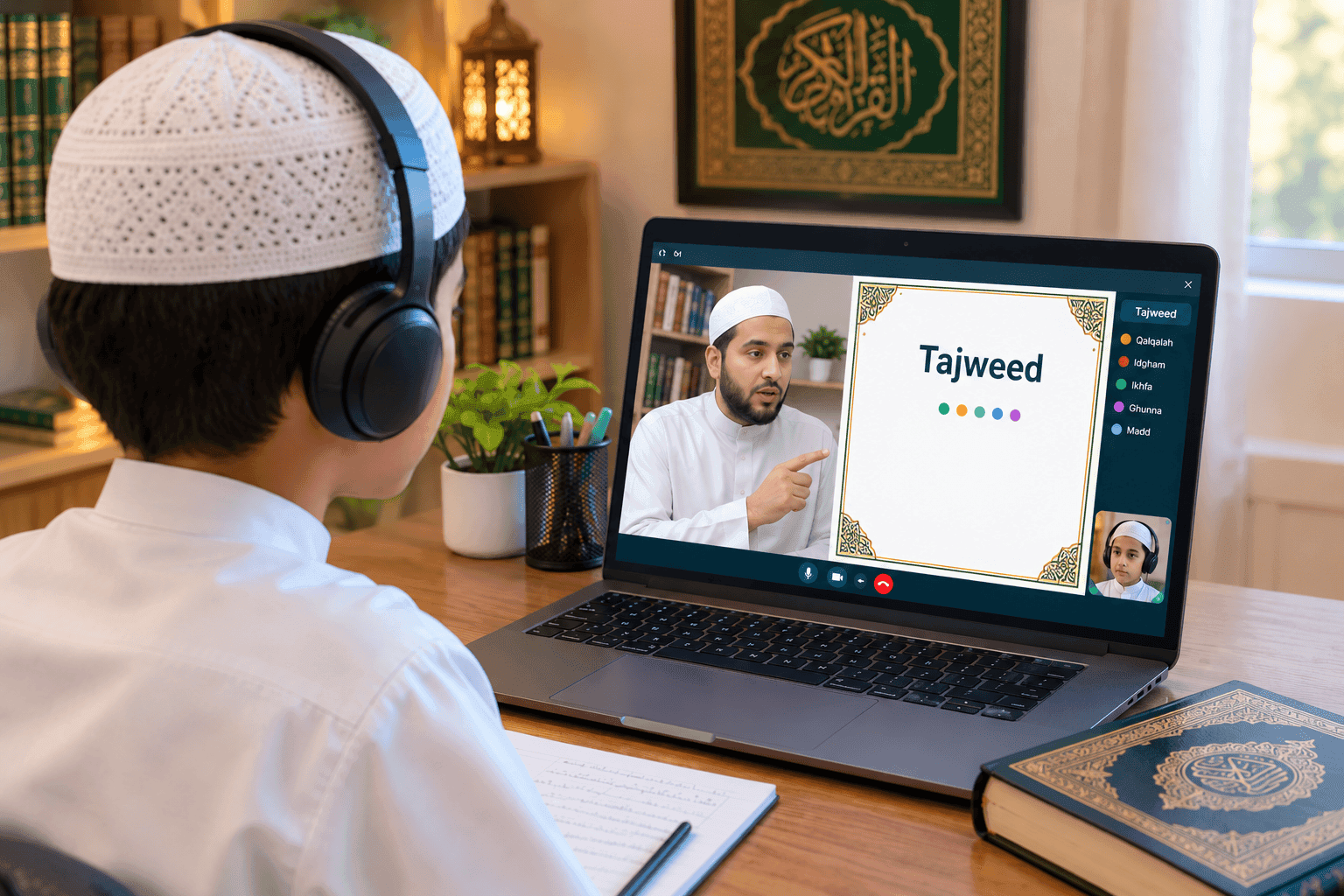
Our online Tajweed classes fix that. You recite live to a teacher, one to one. The teacher listens, corrects you on the spot, and explains each rule in plain language.
What Is Tajweed?
Tajweed is the set of rules for reciting the Quran correctly. It covers where each letter comes from in the mouth and throat, how long a sound lasts, and how letters affect each other when they meet.
The Quran itself asks for careful recitation, in Surah Al-Muzzammil (73:4), which means to recite the Quran slowly, in measured tones. Tajweed is how learners put that into practice.
وَرَتِّلِ الْقُرْآنَ تَرْتِيلًا
It is not decoration. A wrong sound can change a letter, and good Tajweed protects the words as they were recited.
Who This Course Is For
If you cannot read Arabic letters yet, start with Noorani Qaida first. Tajweed builds on that base.
What You Will Learn
The course moves in a clear order, so you never study a rule before you are ready for it.
Every rule is practised on real verses from the Quran, not only on examples in a book.
How Our One-to-One Classes Work
Classes run on a screen with voice, so the teacher can hear your pronunciation clearly. You only need a phone, tablet, or computer and a stable internet connection.
Why One-to-One Works Better for Tajweed
Tajweed is a skill of the ear and the mouth. You cannot learn it well from a video alone, because a video cannot hear you.
In a one-to-one lesson, the whole session is about your recitation. Your teacher notices the small things: a letter that is slightly too soft, a vowel that is too short. In a crowded class, those errors often pass unnoticed.
Tajweed for Kids
Children learn sound patterns quickly, and early habits tend to last. That is why starting with correct Tajweed saves time later.
For young learners, lessons stay short, focused, and repetitive. Parents can sit in, listen, and support practice at home.
Tajweed for Adults
Adults often feel shy about reciting, especially after years of reading the Quran alone. Our lessons are private and patient. Nobody is watching but you and your teacher.
Adults also bring a useful strength: they can understand the logic behind each rule, which makes memory easier.
How Long Does It Take to Learn Tajweed?
It depends on your starting level, how often you attend, and how much you practise between classes. Someone who already reads fluently will move faster than someone still building reading speed.
We do not promise a fixed finishing date. Your teacher will tell you honestly where you stand and what comes next.
Frequently Asked Questions
Do I need to know Arabic before starting?
You need to read Arabic letters and short words. You do not need to understand the language. If you cannot read yet, begin with Noorani Qaida.
Can I learn Tajweed online?
Yes, if the lessons are live and one to one. Live correction is what makes online Tajweed work.
Can my child and I learn at the same time?
No. Tajweed is for anyone who recites the Quran, whether for daily reading, prayer, or Hifz.
Can my child and I learn at the same time?
Noorani Qaida teaches you to read Arabic letters and basic sounds. Tajweed teaches the full rules of correct recitation. Most students do Qaida first.
Can my child and I learn at the same time?
Please contact us. We can discuss schedules that suit your family.
Start With a Free Trial Class
Not sure where your recitation stands?
Book a free trial and recite a few lines for a teacher. You will leave knowing exactly what to work on.